Walt Whitman by David S. Reynolds
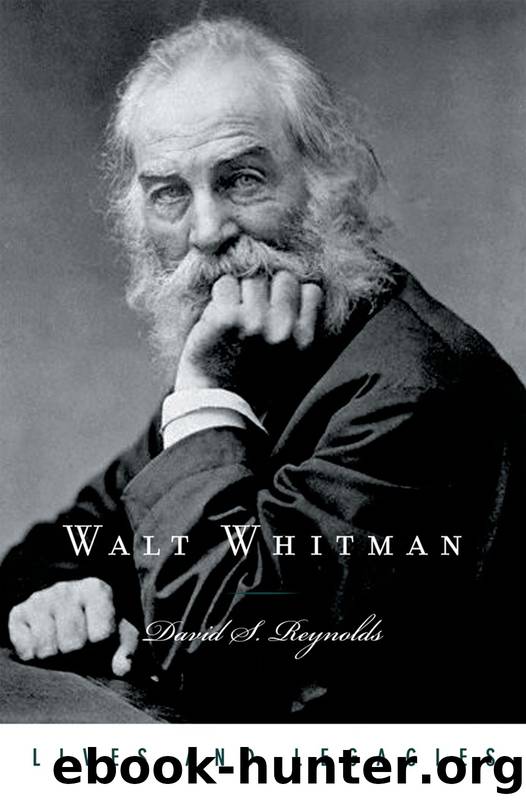
Author:David S. Reynolds [Reynolds, David S.]
Language: eng
Format: epub
Publisher: Oxford University Press
Published: 2005-01-15T05:00:00+00:00
Down-hearted doubters dull and excluded,
Frivolous, sullen, moping, angry, affected, dishearten’d, atheistical,
I know every one of you, I the sea of torment, doubt, despair, and unbelief.5
Whitman, however, had wide-ranging strategies for combating doubt. One he found in physical science. Among the scientists who offered hopeful explanations of nature was the Stockholm chemist Justus Liebig. When the American edition of Liebig’s Chemistry in Its Application to Physiology and Agriculture appeared in 1847, Whitman raved about it in the Eagle. “Chemistry!” he wrote. “The elevating, beautiful, study… which involves the essences of creation, and the changes, and the growths, and formations and decays of so large a constituent part of the earth, and the things thereof!” Liebig’s fame was “as wide as the civilized world—a fame nobler than that of generals, or of many bright geniuses.”6
Liebig presented a scientific rationale for what would become one of Whitman’s main answers to cynics: even if matter were all, nature constantly regenerates itself and turns death into life through chemical transformation. Liebig gave the idea of the cycle of nature validity through the study of transferred chemical compounds. When people and animals died, their atoms became transferred to the earth and plant life, whose atoms in turn became the source of new life. Whatever diseases they had were lost in the transforming process.
There seemed, then, to be an ongoing resurrection and a democratic exchange of substances inherent in nature. Just as Liebig wrote that “the active state of the atoms of one body has an influence upon the atoms of a body in contact with it,” so Whitman announced in the second line of his opening poem that “every atom belonging to me as good belongs to you.”7 As Liebig said that after death humans are changed into other things, so Whitman could write: “We are Nature […] / We become plants, trunks, foliage, roots, bark, / We are bedded in the ground, we are rocks, / We are oaks.”8 If Liebig envisaged an exchange of life forms through decomposition and regrowth, so Whitman fashioned metaphors that vivified the idea of the ceaseless springing of life from death: “Tenderly will I use you curling grass, / It may be you transpire from the breasts of young men”; “The smallest sprout shows there is really no death”; “And as to you Corpse I think you are good manure.”9 Liebig wrote that “the miasms and certain contagious matters [that] produce diseases in the human organism” become “not contagious” when the organism is absorbed into the earth.10 This becomes the central point of Whitman’s poem “This Compost.” He asks the earth in amazement: “Are they not continually putting distemper’d corpses within you? / […] Where have you drawn off all the foul and liquid meat?”11 He provides the Liebigian answer:
Download
This site does not store any files on its server. We only index and link to content provided by other sites. Please contact the content providers to delete copyright contents if any and email us, we'll remove relevant links or contents immediately.
The Universe of Us by Lang Leav(15076)
The Sun and Her Flowers by Rupi Kaur(14517)
Adultolescence by Gabbie Hanna(8927)
Whiskey Words & a Shovel II by r.h. Sin(8018)
Love Her Wild by Atticus(7757)
Smoke & Mirrors by Michael Faudet(6191)
Wiseguy by Nicholas Pileggi(5784)
The Princess Saves Herself in This One by Amanda Lovelace(4975)
Love & Misadventure by Lang Leav(4846)
Memories by Lang Leav(4799)
Milk and Honey by Rupi Kaur(4748)
Bluets by Maggie Nelson(4556)
Too Much and Not the Mood by Durga Chew-Bose(4348)
Pillow Thoughts by Courtney Peppernell(4283)
Good morning to Goodnight by Eleni Kaur(4233)
The Poetry of Pablo Neruda by Pablo Neruda(4106)
Algedonic by r.h. Sin(4063)
HER II by Pierre Alex Jeanty(3611)
Stuff I've Been Feeling Lately by Alicia Cook(3458)
